


Many vehicle owners and transport businesses often focus on adding AdBlue at the right time but pay little attention to the expiration date of the solution. In reality, the quality of AdBlue directly affects the performance of the SCR system, its ability to treat exhaust gases, and the durability of related components. Improper storage or using the product after it has been stored for too long can lead to many operational risks. Therefore… Does AdBlue expire? And what should users keep in mind to ensure the quality of the solution before use? Read the article below to find out more details.
1. Does AdBlue expire?
The answer is yes. According to ISO 22241 standards, AdBlue (AUS32) typically has a shelf life of 12 to 18 months, depending on storage conditions. In ideal conditions such as a dry, clean place, away from direct sunlight and at temperatures below 30°C, the solution can maintain its quality for the maximum period. Conversely, if stored at high temperatures or frequently exposed to sunlight, AdBlue may degrade more quickly.
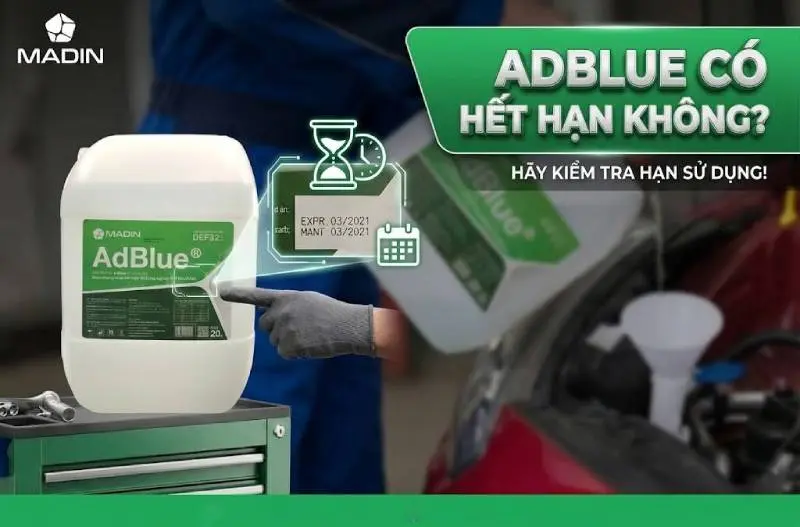
The reason is that AdBlue is composed of 32.5% pure urea and 67.5% demineralized water. These two components are quite sensitive to temperature, light, and impurities from the external environment. When the quality of the solution changes, the efficiency of NOx gas treatment in the SCR system also decreases.
Therefore, in addition to choosing AdBlue that meets standards, vehicle owners and transport businesses need to pay attention to the expiration date and storage conditions to ensure the exhaust gas treatment system operates stably and avoids unnecessary damage.
2. Signs that AdBlue has expired or deteriorated.
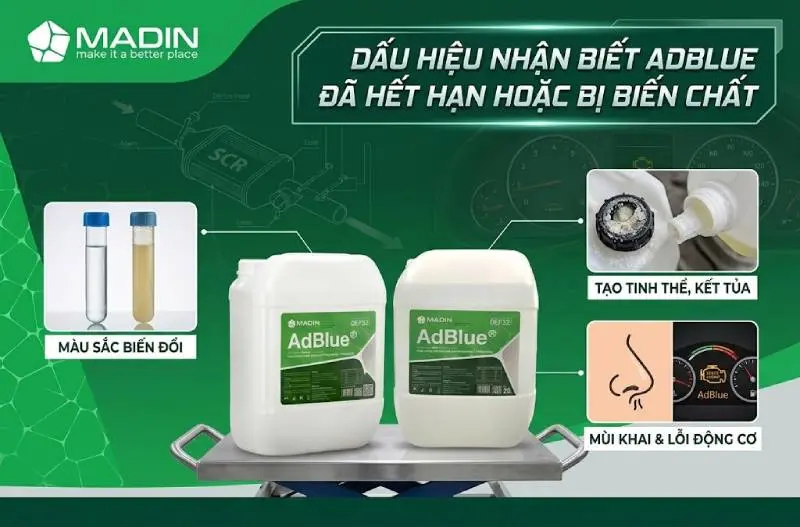
Before adding AdBlue to your vehicle, users should check the fluid’s condition to avoid affecting the SCR system. The following signs may indicate that AdBlue has expired or is no longer of good quality:
- Color-changing solutionStandard AdBlue is usually clear. If the solution turns pale yellow, cloudy, or shows any unusual color, it is highly likely that it has deteriorated or been contaminated.
- Presence of sediment or particlesWhen observing with the naked eye, if small particles, sediment, or impurities are seen floating in the solution, users should not continue using it as it may affect the AdBlue fuel injectors.
- It has a strange smell or a strong urine odor.AdBlue is of almost no noticeable odor. If a strong, pungent or unusual odor is present, the urea structure may have decomposed due to improper storage conditions.
- White crystals appear in the bottle or cap.Crystallization indicates that the concentration of the solution has changed due to evaporation or external environmental factors. This is a common sign of degraded AdBlue quality.
- The solution has been stored for longer than the recommended time.If AdBlue has been stored for over 12-18 months without clear records, users should check its quality before use to minimize risks to the SCR system.
Upon detecting any of the above signs, vehicle owners should replace the old AdBlue with a new, compliant one to ensure effective exhaust gas treatment and protect critical vehicle components.
3. Important notes when using AdBlue solution
Proper use of AdBlue not only helps the SCR system operate efficiently but also reduces emissions-related problems and repair costs. Below are some important points that diesel vehicle users need to know.
Only use AdBlue that meets quality standards.
AdBlue quality directly impacts performance. SCR system. Users should choose products that meet ISO 22241 standards to ensure the purity and urea concentration meet technical requirements. Using AdBlue of unknown origin or poor quality may reduce its NOx treatment capacity, clog fuel injectors, and affect the lifespan of the SCR catalytic converter.
Do not mix AdBlue with other solutions.
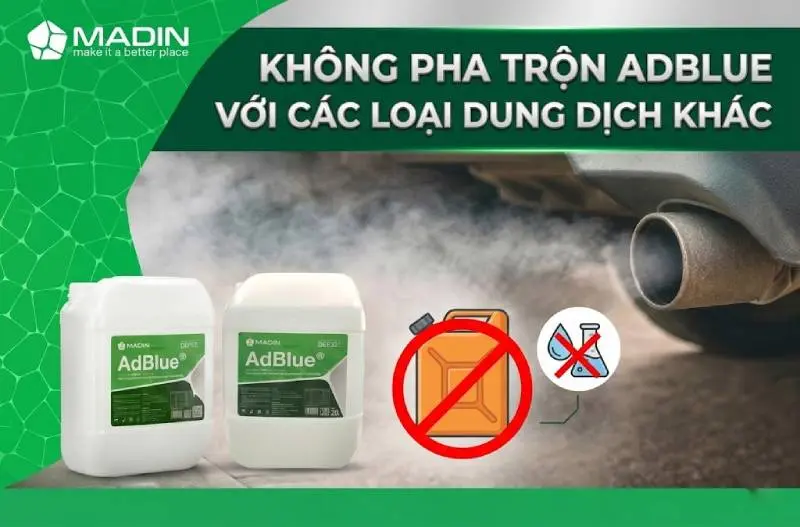
AdBlue is a solution manufactured according to strict standard ratios. Adding water, chemicals, or any other liquid can alter the urea concentration and affect the performance of the exhaust gas treatment system. Even a small amount of impurity can cause sensor malfunctions or reduce the operational efficiency of the SCR.
Pour AdBlue into the designated container.
Many first-time diesel vehicle users may confuse the fuel tank with the AdBlue tank. Incorrect placement can cause serious damage to the fuel or exhaust system. Therefore, it’s essential to carefully check the markings on the tank cap and refuel according to the manufacturer’s instructions.
Monitor your AdBlue levels regularly.
Most modern diesel vehicles are equipped with an AdBlue level warning sensor. However, users should not wait until the warning light appears before adding fluid. Regular checks allow for proactive refueling planning and prevent performance issues such as reduced power or other operational problems.
Store AdBlue under proper conditions.
AdBlue should be stored in a dry, clean place, away from direct sunlight and high heat sources. Do not reuse containers, drums, or tanks that have previously held other chemicals due to the high risk of contamination. After use, tightly close the lid to prevent moisture and dust from entering and affecting the quality of the solution.
4. AdBlue® By Madin – A solution for protecting SCR systems and diesel engines.
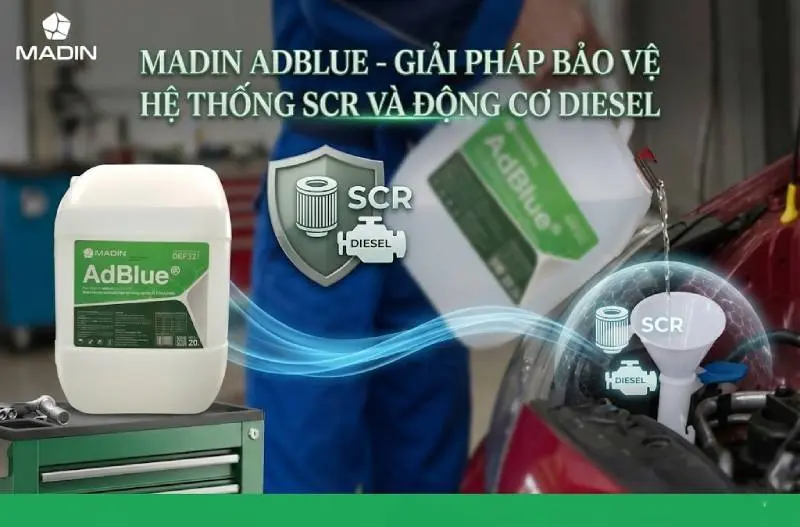
For modern diesel vehicles, selecting a compliant AdBlue product is crucial for the stable operation of the SCR system and maintaining effective exhaust gas treatment. AdBlue® By Madin is manufactured to rigorous quality standards, meeting the requirements for use in a wide range of trucks, buses, trailers, and diesel vehicles equipped with SCR technology.
With its AUS32-standard composition of 32.5% pure urea and 67.5% demineralized water, AdBlue® By Madin supports the conversion of NOx gases into nitrogen and water vapor, contributing to a reduction of up to 90% in harmful emissions. At the same time, the product helps protect AdBlue injectors, NOx sensors, and SCR catalytic converters from risks arising from the use of low-quality solutions.
In addition to its effective exhaust gas treatment, AdBlue® By Madin also provides transport businesses and vehicle owners with greater peace of mind during vehicle inspections, operation, and compliance with Euro 4, Euro 5, and Euro 6 standards. With years of manufacturing experience and a rigorous quality control system, AdBlue® By Madin is the right choice for businesses seeking an effective, safe, and sustainable solution to protect their exhaust systems and diesel engines.
Conclusion
Based on the information above, it can be seen that Does AdBlue expire? This is a matter of concern for all diesel vehicle owners. Using AdBlue that is within its expiration date, properly stored, and meets quality standards will help the SCR system operate stably, maintain exhaust gas treatment efficiency, and limit unnecessary repair costs. To ensure a quality AdBlue supply for your vehicle, AdBlue® By Madin is the suitable choice for modern diesel vehicles, supporting NOx emission reduction and protecting the exhaust system. Contact us today! Madin For detailed advice and to choose the product that best suits your actual needs.
CÔNG TY TNHH MTV MADIN
- Address13 Le Ngung Street, Tran Hung Dao Ward, Quang Ngai City, Quang Ngai Province, Vietnam.
- Group: +84 888 718 778
Factory:
North
- Address: Road 206, Pho Noi A Industrial Park (Thanh Ha Warehouse), Lac Hong Commune, Van Lam District, Hung Yen Province, Vietnam.
- Group: +84 857 529 222
Southern
- Address180 Thong Nhat Street, Binh Thang Ward, Di An City, Binh Duong Province, Vietnam
- Group: +84 888 718 778
Warehouse:
- Hanoi706 Nguyen Khoai Street, Thanh Tri Ward, Hoang Mai District, Hanoi
- Nghe An: Dien Hong Industrial Zone – Dien Chau – Nghe An
- Da Nang303 Le Dai Hanh Street, Hoa Phat Ward, Cam Le District, Da Nang City
- Quang Ngai13 Le Ngung Street, Tran Hung Dao Ward, Quang Ngai City, Quang Ngai Province