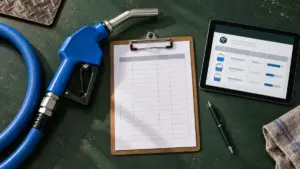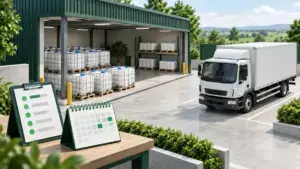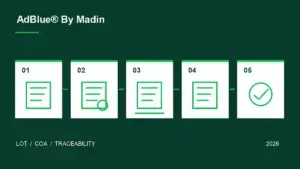



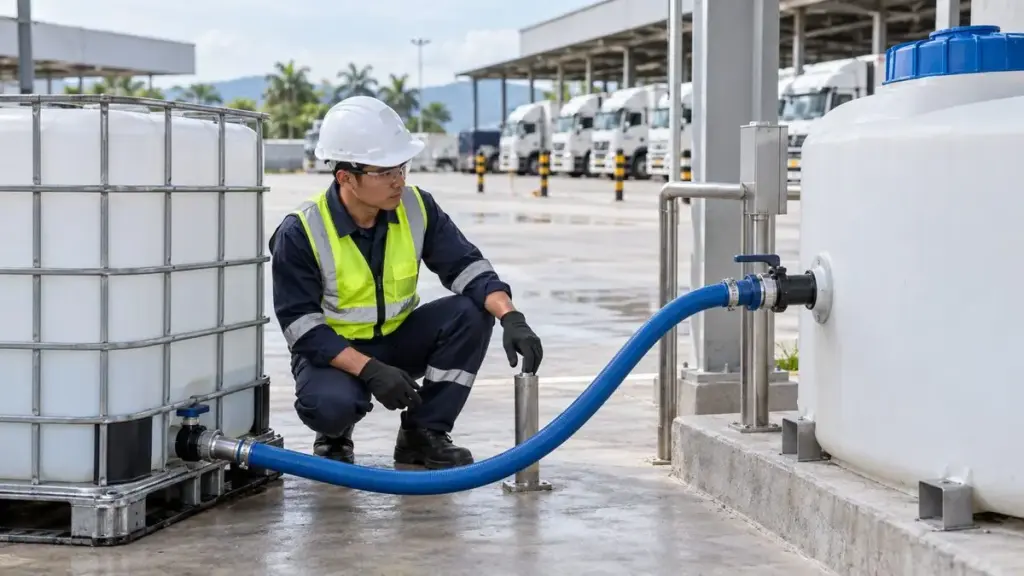
AI concept illustration, not a photograph of a MADIN or customer site; verify actual equipment and procedures.
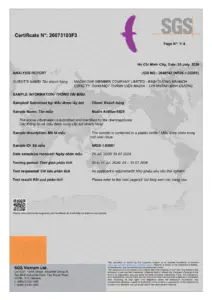
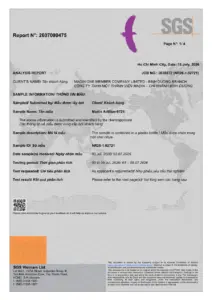
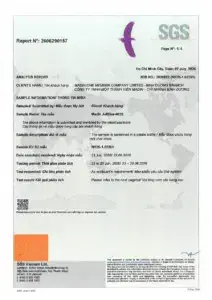
An AdBlue/DEF batch can arrive with the right paperwork and still be exposed to contamination at a depot connection. Before transfer, check the receiving tank, hose, fittings and the record linking the IBC to its batch. A COA records the quality tested for a batch at a sampling point; it does not establish that today’s transfer path is clean.
Before connecting the hose
- Match the IBC label, batch and seal with the receiving record. If the delivery is still being checked, use the batch-COA receiving checklist first. Identify the intended receiving tank; do not rely on a handwritten assumption about its contents.
- Confirm that surfaces which will contact AdBlue/DEF are suitable and free of visible foreign matter. Check the hose, fittings, caps and connections. Equipment dedicated to AdBlue/DEF should be identified as such. If equipment was used for another product, do not treat an undocumented rinse as proof that it is ready: follow the site’s approved cleaning and verification procedure.
- Keep the transfer path closed as far as the equipment design permits. Check caps and tank vents against the equipment instructions so dirt cannot enter through an open connection. Record the batch, tank and transfer time in the operating log.
If something does not check out
Pause the transfer if the seal, previous contents, cleaning record or connection condition is uncertain. Segregate the affected material and record what was observed; ask the responsible quality person to decide whether testing, cleaning or another action is required under the site’s procedure. Do not dilute the material or continue pumping simply to see whether the vehicle accepts it.
After a completed transfer, reconcile the quantity and batch record with the shift dispensing and tank-stock log. A quantity reconciliation helps trace the movement; it is not a substitute for a quality check.
Frequently asked questions
Does a passing COA mean the transfer hose needs no check? No. The COA covers the sampled batch under its stated test conditions. A depot hose and connection still need their own checks before use.
Can any rinsed IBC or hose be reused? Do not assume so. Check material compatibility, prior use and documented cleaning/verification under the applicable procedure. If those facts are unavailable, stop and escalate instead of treating visual appearance as proof.
Who decides what to do after suspected contamination? The designated quality/operations owner should follow the site’s procedure and documented evidence; this article cannot decide the disposition of a specific lot.
Need to review the receiving, storage and transfer steps for your depot? Contact MADIN with the equipment type and operating context so the team can discuss the appropriate next check. No response time or outcome is promised.