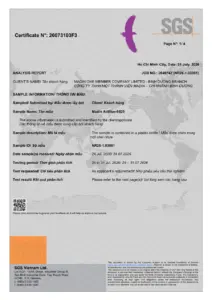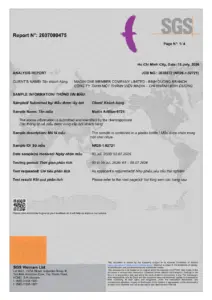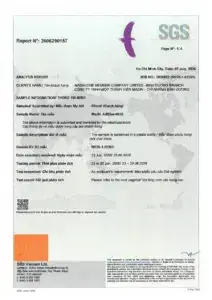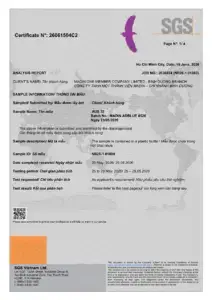



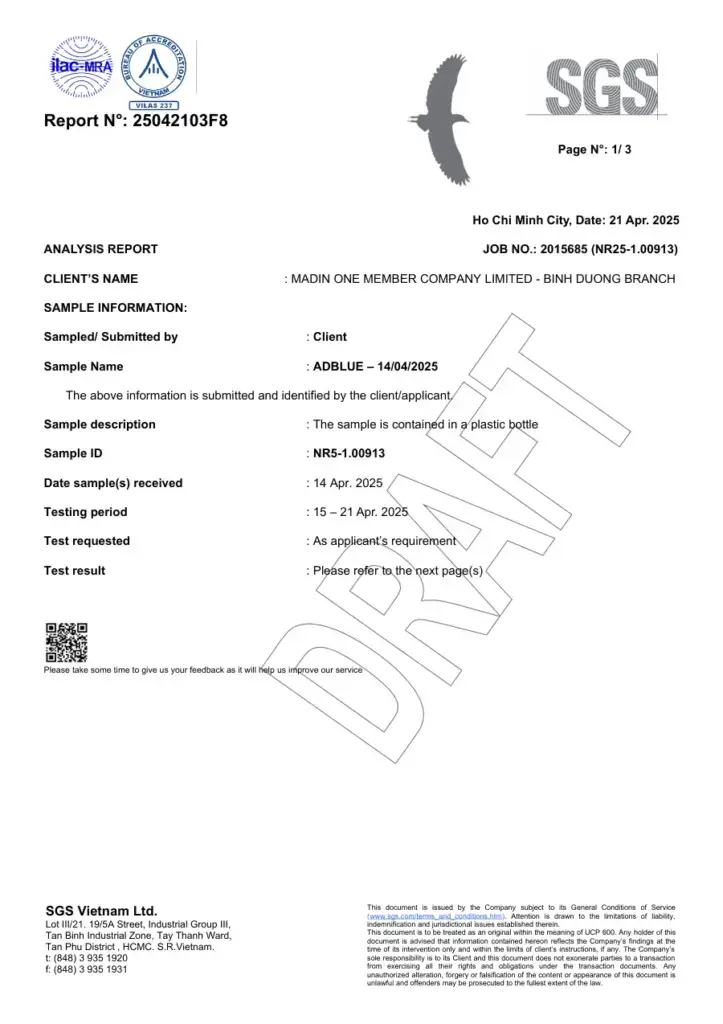
An additional SGS Vietnam spot check on AdBlue sampled 14 April 2025, covering Phosphate, Calcium. Report 25042103F8.
Report details
Measured results
| # | Parameter | Method | Result | Unit | Limit |
|---|---|---|---|---|---|
| 1 | Phosphate (as PO4 3-) | ISO 22241-2:2019 | <0.3 | mg/kg | — |
| 2 | Calcium (Ca) | — | N.D (LOD=0.03) | mg/kg | — |
What these numbers mean
Urea content and density fix the concentration. AUS 32 is 32.5% urea by weight and an SCR system doses on that assumption: too weak and NOx conversion falls short, too strong and urea crystallises in the injector.
Biuret forms when urea is overheated during manufacture. It will not convert to ammonia and it deposits in the dosing line, which is why the limit is a tight 0.3%.
Metals — calcium, iron, copper, zinc, chromium, nickel, aluminium, magnesium, sodium and potassium — poison the SCR catalyst permanently, so limits sit at 0.2–0.5 mg/kg. “N.D” means not detected above the laboratory’s 0.03 mg/kg detection limit.
Insoluble matter and phosphate block the injector and coat the catalyst; aldehyde and alkalinity flag contamination of the urea feedstock.
About the standard
AUS 32 (Aqueous Urea Solution 32.5%) is defined by ISO 22241-1. AdBlue® is the registered trademark of the German Association of the Automotive Industry (VDA) for fluid meeting that specification. Madin holds a VDA licence to use the AdBlue® trademark (certificate 0005431, valid to 16 October 2028) and is certified to ISO 9001:2015 for the manufacture and supply of aqueous urea solution (certificate 22/17582, valid to 10 October 2028).
The limit column above is the specification supplied to the laboratory; SGS notes on each report that limits are based on the client’s specification. Urea content is measured to ISO 22241-2:2019 and density to ISO 12185:1996.
The report itself
The full SGS document, exactly as issued – all three pages, including the laboratory’s remarks and the photograph of the sample as received.