



Euro Emission Standards is a system of regulations on maximum emissions concentration; permitted for vehicles; Machines are sold in the European market. The objective of this standard is to reduce environmental pollution; Due to emissions for vehicles, machines operated by diesel engines.
Impact of applying Euro emission standards
- Reduce environmental pollution: Euro standards help reduce toxic emissions; from motor vehicles, contributing to the protection of human health and the environment.
- Improve the quality of motor vehicles: Manufacturers are forced to adopt more advanced technologies to meet Euro emission standards, thereby improving the quality of motor vehicles.
How effective were the euros?
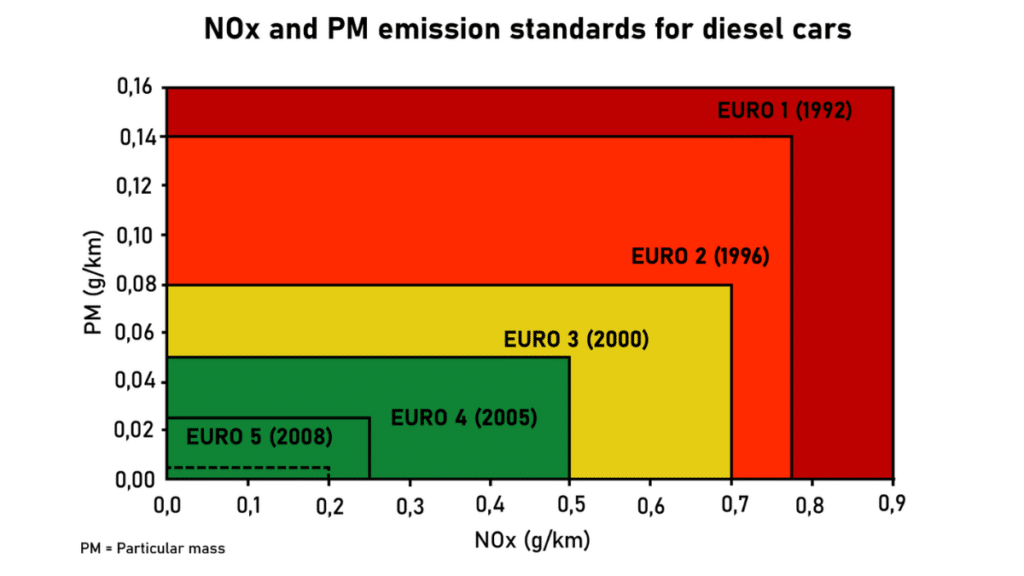
According to data from the Association of Manufacturers & Automotive business, euro emission standards have had a significant impact on emissions.
Since 1993, carbon monoxide levels have decreased by 82% for diesel cars and 63% for gasoline and granular substances decreased by 96%. Since 2001, nitrogen oxide has decreased by 84% and hydrocarbons have decreased by 50% in gasoline-powered cars..
History of application of Euro emission regulations in Vietnam
- 2009: Vietnam begins to apply Euro 2 emission regulations for domestically manufactured and assembled motorbikes and cars.
- 2015: Vietnam upgrades to Euro 4 standards for domestically manufactured and assembled motorbikes and cars.
- 2018: Vietnam begins to apply Euro 5 emission standards for new imported cars.
- 2022: Vietnam officially applies Euro 5 standard for all new cars manufactured, assembled and imported.
According to Decision 49/2011/QD-TTg, from January 1, 2022, newly imported and assembled cars into Vietnam must meet Euro 5 standards..
What is the emission standard level 5?
Currently, cars circulating in Vietnam are applying the level 4 regulations. Level 5 emission standard is said to help create cleaner cars, emit less toxic substances, reduce environmental pollution.
Emissions Regulation Level 5 is the standard limiting pollutants contained in automobile emissions corresponding to the Euro 5 level specified in the motor vehicle emissions specification of the United Nations European Economic Commission of the United Nations or in the European Union directive applicable to motor vehicles new export, assembly and import. Standard level 5 has very strict and specific regulations on the limit of quantity – weight of particles discharged to the outside. Euro 5 emissions regulation also applies the calculation of dust particle volume in the exhaust gas engine directly.
Specifically:
The level 5 emission standard promoted the introduction of diesel engine particle filter (DPFS) for all diesel cars. A particle limit is also given for direct injection gasoline engines.
An additional limit on the number of particles discharged from diesel engines is also introduced for cars registered from January 1, 2013.
Euro 5 emission limit (gasoline) CO: 1.00g/km HC: 0.10g/km NOx: 0.06g/km PM: 0.005g/km.
Euro 5 emission limit (Diesel engine) CO: 0.50g/km HC + NOx: 0.23g/km NOx: 0.18g/km PM: 0.005g/km PM: 6.0×10 ^ 11/km
In the world, cars have standards from Euro 1 to Euro 6. In addition, at present, details of the emission standard level 7 (Euro 7), the final standard, is expected to be announced in 2021 or 2022 and can be effective force by 2025. The details of Euro 7 could be affected by the European Green Deal targets to reduce carbon dioxide emissions.
Notes when applying the emission standard level 5
Level 5 gasoline has higher technical requirements than lower gasoline levels. The car is equipped with Euro 5 but uses fuel that does not meet the standards, which may cause errors or damage to some details such as fuel injectors, DPF system (particle filter of diesel engine), A/F sensor (wide-band oxygen sensor), oxygen sensor … reduce age engine life due to high sulfur content in fuel; Formation of acid H2SO4 causes corrosion of drive parts in the engine… When the exhaust gas treatment system reports an error, the engine power will be limited, causing engine weakness and increasing fuel consumption.
Vehicle manufacturers always recommend that customers use fuel with a standard level equivalent to or higher than the vehicle’s emission standards. If the vehicle is faulty or damaged due to the fuel not meeting Euro 5, depending on the policy of each company, the customer will be supported to handle and warranty..
Thus, Euro 5-standard engines using fuel level 5 are the most reasonable, avoiding or minimizing the use of gasoline with other quality levels..
Conclude
The adoption of the Euro emission standard is an effective solution to protect the environment and improve the quality of motor vehicles. Consumers should prioritize the use of vehicles that meet Euro emission regulations to contribute to the protection of public health and the living environment.